


The Resting Place of Mayflower Voyagers and Salem Witch Trial Judges: Charter Street Cemetery


Today, we talk about one of the earliest cemeteries in America. Located on Charter Street in Salem,Massachusetts, the Charter Street Cemetery has laid to rest America’s earliest settlers. Yes, some from the Mayflower and some people involved with the Salem Witch Trials. This primarily serves as an overview of the cemetery. In future articles, I will address specific incidents or individuals.
The Early History of the Cemetery
The cemetery was established in 1637 and is Salem’s oldest cemetery. Some of the early
people buried there were passengers on the Mayflower.
Old Grave Symbols
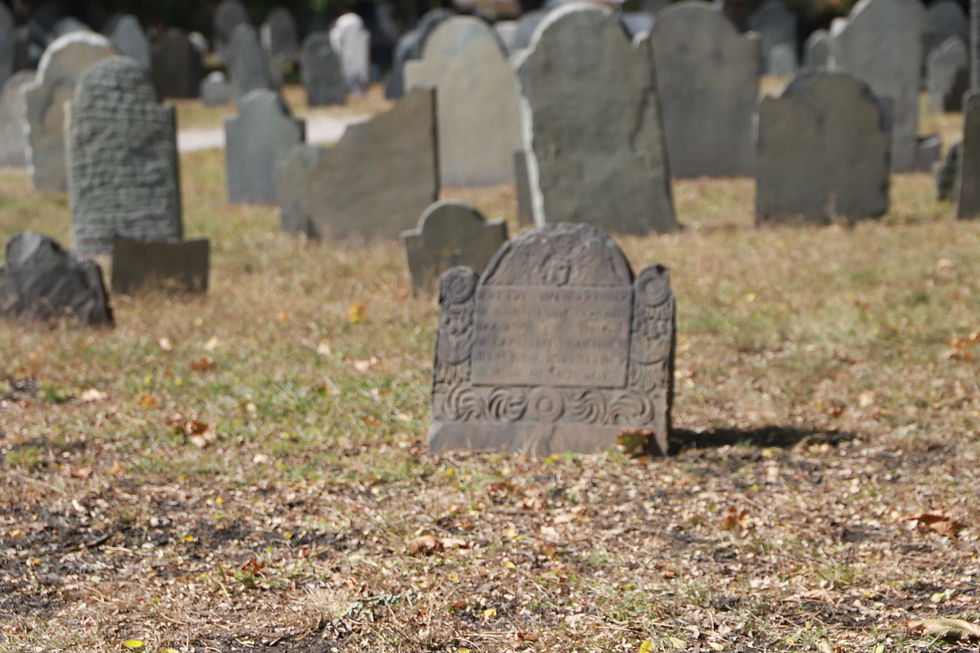
If you read my previous article History of Graves Volume 1 you might recognize some of the graves in this photo. Here is a Cliff Notes version from that article.
The Death Head—Late 1600s to very early 1700s tombstones often depicted a skull head with wings.

Cherub Head—Another familiar early icon in the 1700s used on tombstones was the cherub head. It would not typically be seen on a grave belonging to someone of the Puritan faith, as they didn’t want cherubs on a grave to attribute the human soul on the same level as an angel or God. Some views softened slightly within Puritan faith, but this would not have occurred until the mid- to late 18th century.
Willow—The willow represents sadness and mourning on graves. It became more popular in the late 1700s.
Urn- This symbol became more popular in the late 1700’s and 1800’s. It was during this time that many Americans became even more fascinated with classical Greek and Roman architecture.
Salem Witch Trials and connections
The most notable figure involved in the Salem Witch Trials of 1692 is Judge John Hathorne. He was the man that was responsible for the fate of the Salem Witch Trial victims. He died in 1717. Never once did he apologize for his role. His descendant who was writer Nathainal Hawthorne condemned his ancestor’s involvement where he even added a “W” to Hathorne to distance himself from his family’s legacy.
Speaking of Hawthorne one of the alleged inspirations for Hester Prynne is Eleanor Hollingworth, whose mother and father were Phillip and Mary English, who were accused during the Salem Witch Trials and jailed. They were able to escape due to their wealth and fled to New York till the hysteria died down. Eleanor also ran the Blue Anchor Tavern after her husband passed.
Mary Corey, who was Giles Corey’s second wife who died eight years before the trial, is also buried in the cemetery.
What about the victims?
After most of the victims were executed, they were buried in unmarked graves. A few of the victims were unearthed by family members years later for a proper burial, but most never received a proper Christian burial. The closest thing to a mention of them is the memorial dedicated to the victims outside the cemetery exit.
The Last Interments
Burials ceased in the 1800s, although many sources allege that, when I examined the cemetery’s database, a few recent burials were in 1904. Perhaps they already had plots purchased for them in the early 1800s, and they simply did not take on more people? Most notable burials, however, were in the 1600s and early 1700s.
Pickman House

On the perimeter of the cemetery is also the Pickman House. This house is among the oldest buildings in the United States, estimated to be over 300 years old. The original owners were Samuel Pickman and his wife, Lydia. Samuel was a sailor. Lydia was one of the women who would examine the accused for strange birthmarks or moles during the Salem Witch Trials.
Other residents of the Pickman House over the centuries included painter Michele Felice Corne. Another resident was Chief Justice Benjamin Lynde Jr., who oversaw the 1770 Boston Massacre Trial.
In 1964, Historic Salem purchased the property. Renovations began and were not completed. Phillip A. Budrose swooped in and completed the restoration. Today, it is a museum where visitors can walk through to view this home that is a few centuries old.
Since the 1970s, tours have been conducted and continue to attract visitors. The Peabody Essex Museum assumed ownership in 1983. This house also has numerous ghost stories, which deserve their own article for another time.
Before going to Charter Street Cemetery
Another thing to note is that you must go online and make a reservation to enter the cemetery. I failed to look up that part, so I was not able to get in. Although I was unable to attend, it did not prevent me from taking pictures over the wall or from discussing it.


Comments